Plants and Form

Explorers collected and preserved plants to bring their beauty to their homes far away. Early healers preserved plants to treat their patients. I preserve plants for their beauty and the richness of their history.

Click on any image below to see it larger.

Posted in Green Art | Comments Off

The Tallgrass Prairie

The cold wind in the Flint Hills, on a “warm” winter day, was brutal. I took a trip to the Flint Hills to collect some winter-dried grasses before the killer part of our winter set in. 

I wasn’t ready for an early sunset, but the moon was rising large and orange,  the temperature slid lower, my nose ran more freely,  I was knee deep in prairie grass and surrounded by the woody remains  of an old train station  in ever  increasing darkness.

Heading home in dark night (at 6:00), the huge expanses of ancient prairie were barely visible.

Because the gravely, flint-laden soil make the land suitable for ranching, not farming, the plants here are botanical descendents of what’s been here for millions of years – the tallgrasses like Little Bluestem and Switchgrass.

This particular area has the largest untilled tallgrass prairie in North America.

Continue reading

Posted in Uncategorized | Comments Off

Lavender

Lavender has been growing wild for all of recorded history. I’ve preserved this most lovely specimen to create truly green art.

It’s not the best picture – the color is actually rich and green. It hasn’t changed much in the six years I’ve had it.

Lavender is one of the most powerful herbs and is widely used, from treating stress and depression, to speed healing, and kill bacteria.

Historically it’s been used in cleaning and as a perfume. During the peak of the Roman times, one pound of good lavender was sold for the price of an average worker’s monthly salary.

Now it’s known to have antiseptic and anti-inflammatory properties.  It can aid sleep and relaxation, treat burns and helps acne. Dried lavender is a highly desireable fragrance and deters moths.

I’ve loved this piece of lavender for years, but I never framed it. I was happy to let it go as part of a series to a new home.


Posted in Green Art, Herbs | Tagged Topics | Comments Off

Small Native Pieces

I used to think the variety of plant material available to me here in the midwest was sadly limited. I was always planning trips and fantasizing about the exotic plant material I would find.

Traveling around a bit is great, and I’ve also developed a better appreciation for what’s here.

Pictured in this post are several small 3″ x 8.5″  matted pieces, that all use native plants, and are great examples of eco art.

To the right here are Sea Oats and Little Bluestem.

Below are Wood Fern / Paw Paw, Lamb’s Ears / Paw Paw, Sea Oats / Hydrangea as layered pieces (in that order).

Continue reading

Posted in Botanical Artifacts, Native Plants | Tagged Topics , , | Comments Off

Multiple Layers

I recently started using  multiple layers of plant material to add depth and dimension. 


Continue reading

Posted in Green Art, Native Plants | Comments Off

City of Alexandria Herbarium

I found historic type specimen and unusual plant material at the City of Alexandria, VA herbarium.  While I had hoped to get into the United States National Herbarium at the Smithsonian to see historic specimen,  I got to see some of what I was hoping for here because of sharing that always occurs among herbaria.

This label is for a plant specimen that’s not only from the famous national herbarium, but it’s also a “type specimen”  (from Paris, 1921) which indicates it’s the best possible representation of that plant. It’s the reference point for scientists when attempting to identify plants. Type specimen are among the most valuable pieces in an herbarium.

Continue reading

Posted in Botanical Artifacts, Herbaria | Comments Off

University of Maryland Herbarium

There were some beautiful specimen, as well as interesting historical remnants, at the Norton-Brown Herbarium at the University of Maryland. The herbarium was established in 1901 making it one of the oldest in the U.S. (the University of Florida Herbarium is the oldest, established in 1891).

Most of my inspiration comes from historical preserved specimen. The two here are especially nice.  I love seeing plant material that is not otherwise accessible to me.

The Astragalus, left,  was collected in Wyoming in 1971.  The Trillium, right, is from Ohio, 1983.


Early American collection equipment were often metal containers meant to protect the integrity of the plant material (and retain bits that come loose).

Continue reading

Posted in Herbaria, Inspiration, Research | Comments Off

Art and an Indigenous Religion

The Freer Gallery of Art on the national mall  in D.C. houses one of the most outstanding collections of Asian art in the U.S.  It was a highlight of my trip to that area this fall.

Seeing art from the Shinto era was really special. The prevailing religious practice, or more like world view, prior to the arrival of Buddhism in the 6th century, was Shinto. It lacked intellectually complex doctrines, formality, and organization. But, there were many groups of people devoted to the spirits (Kami) of nature that were found everywhere, in plants, animals, mountains, seas, and all natural phenomena. The realms of earth and the supernatural world were so closely integrated that they were seen as part of the same.

Shinto sees divinity in everything, and practicing it is designed to bring us into communion with the Divine.

The image posted above is a Shinto shrine gate, or Torii, marking the shrine entrance. These gates mark the division between the spiritual world and the physical world. The shrines / gates were always located outside.

Continue reading

Posted in Inspiration, International Influences | Tagged Topics , , | Comments Off

Magnolia and Grape Vine Tendrils

Wherever we go in life, we bring with us stories running through our minds and hearts. We might have brief moments of pure experience in the moment,  but those are rare.

When I’m looking at plant material, there’s always something I love about it or have some idea about. I never go to the presses and say “let me find something that looks like…” It’s also really ineffective to try and change the shape of something. Looking at these grapevine tendrils I’m aware of how delicate and lovely they are. I don’t do anything to make them that way. How you see them is exactly how they occured in nature.

.


.
.
.

.
-

Posted in Uncategorized | Comments Off

Papaya

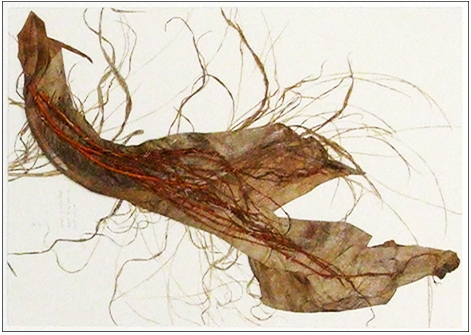
Papaya. It’s native to the Americas Papaya Leaf as Green Artand is one of the healthiest foods you can eat.

When I visited Negril (Jamaica) a few years ago, I noticed the gorgeous leaves everywhere. I brought a plant press with me and did preserve some, but there are heavy restrictions about transporting plant material internationally.

The stunning image of the leaf stayed with me.

While visiting a friend one day I was taken aback when I saw a Papaya tree growing inside his house! He let me collect a few gorgeous leaves. This is one. Totally legal.


Posted in International Influences, Native Plants | Comments Off